BusinessNeel Achary3/18/2026
A decade after its launch, the Digital India programme is no longer just a government initiative. It has evolved into the backbone of India’s economic and service delivery architecture, quietly reshaping everything from banking and payments to welfare distribution and digital commerce.
The scale of transformation is striking. Broadband subscribers have grown from 25 crore in 2014–15 to over 103 crore in 2024–25, a fourfold increase that signals not just connectivity expansion, but the creation of a massive digital consumer base.
This growth has been supported by a rapid expansion of telecom infrastructure. Mobile base stations have nearly quadrupled, while optical fibre networks have expanded exponentially, laying the groundwork for high-speed data access across urban and rural India alike.
The Data Revolution: Cheap, Ubiquitous, Transformative
Perhaps the most consequential shift has been in data consumption. Average monthly usage per user has surged from just 61 MB to over 25 GB. At the same time, the cost of data has dropped by nearly 97 percent.
This combination of affordability and availability has unlocked new markets. From short video platforms and e-commerce to edtech and telemedicine, entire digital industries have scaled on the back of cheap data.
For businesses, this means access to one of the world’s largest and fastest-growing internet user bases, with consumption patterns increasingly mirroring mature digital economies.
Digital Public Infrastructure as a Growth Engine
At the heart of this transformation lies India’s digital public infrastructure stack, often referred to as DPI. Aadhaar, UPI, and the broader JAM trinity have created a foundational layer on which both government services and private innovation now operate.
With over 143 crore Aadhaar identities issued, India has achieved near-universal digital identity coverage. This has enabled seamless onboarding for financial services, telecom, and government schemes.
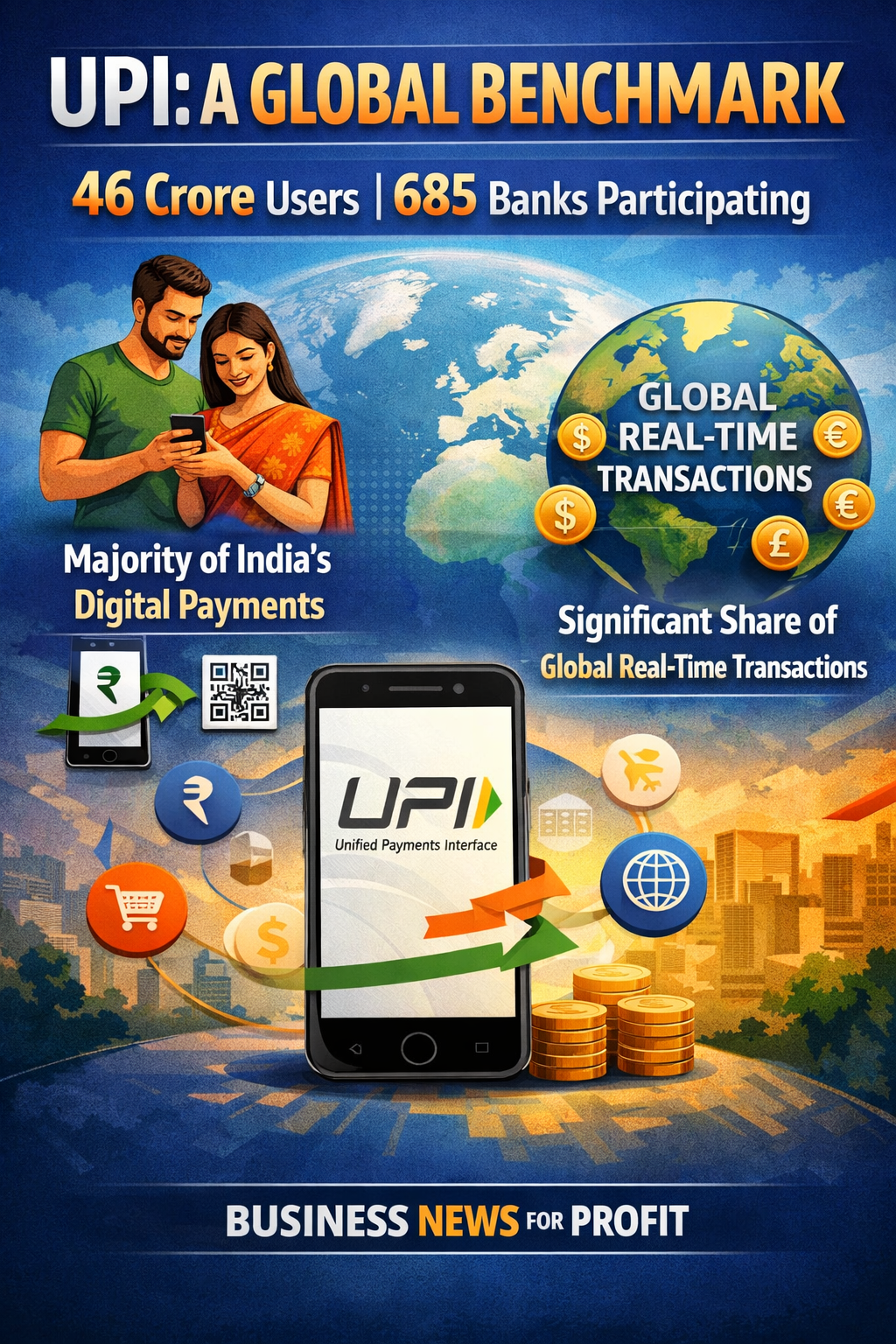
UPI, in particular, has emerged as a global benchmark. With over 46 crore users and participation from 685 banks, it now powers the majority of India’s digital payments and accounts for a significant share of global real-time transactions.
For businesses, UPI has dramatically reduced transaction friction, enabling everything from street vendors to large enterprises to operate in a cash-light ecosystem.
Direct Transfers and Fiscal Efficiency
The JAM trinity has also transformed welfare delivery. Direct benefit transfers worth nearly ₹50 lakh crore have been routed directly to beneficiaries, reducing leakages and improving targeting.
This shift has implications beyond governance. It increases disposable income certainty at the household level, which in turn supports consumption, especially in rural markets.
Platforms That Scale with the Economy
Government-backed platforms such as DigiLocker and UMANG are quietly becoming part of everyday digital infrastructure.
DigiLocker, with 67 crore users and nearly 1,000 crore documents issued, is reducing paperwork and enabling faster verification processes across sectors like banking, education, and transport.
UMANG, offering more than 2,400 services, reflects a broader trend toward platformisation of public services, where citizens interact with the state through a single digital interface.
For private players, these platforms create opportunities for integration, partnerships, and service delivery innovations.
Bridging the Last Mile
One of the more understated achievements of Digital India has been its focus on inclusion. Village-level connectivity has reached near-universal levels, while digital literacy programmes like PMGDISHA have trained over 6.39 crore individuals.
This expansion is critical for unlocking demand in rural India, which remains the next frontier for digital growth.
What It Means for Business
Digital India has effectively created a large, connected, and increasingly data-savvy market. For companies, this translates into:
-
Lower customer acquisition and onboarding costs
-
Faster digital payments and reduced transaction friction
-
Access to verified digital identities
-
Expansion into rural and semi-urban markets
Sectors such as fintech, e-commerce, logistics, health tech, and edtech are already leveraging this ecosystem.
The Road Ahead
The next phase of Digital India will likely focus on deepening usage rather than just expanding access. This includes improving service quality, enhancing cybersecurity, and integrating emerging technologies like AI into public platforms.
As India moves toward a $5 trillion economy, its digital backbone will play a central role in driving productivity, formalisation, and innovation.
Bottom Line
Digital India has moved beyond infrastructure to become an economic multiplier. By combining connectivity, affordability, and scalable platforms, it has created a digital ecosystem that is not only inclusive but also commercially transformative.
For businesses, the message is clear: India’s growth story is increasingly a digital story.
