BusinessSwapna Mallik5/14/2026
New Delhi, May 14 : The PHD Chamber of Commerce and Industry organised the National Conclave on Raw Material Securitization for Metals & Minerals at PHD House, New Delhi on Wednesday, bringing together industry leaders, policymakers, technology providers, research institutions, and stakeholders from the metals, mining, manufacturing, and recycling sectors.
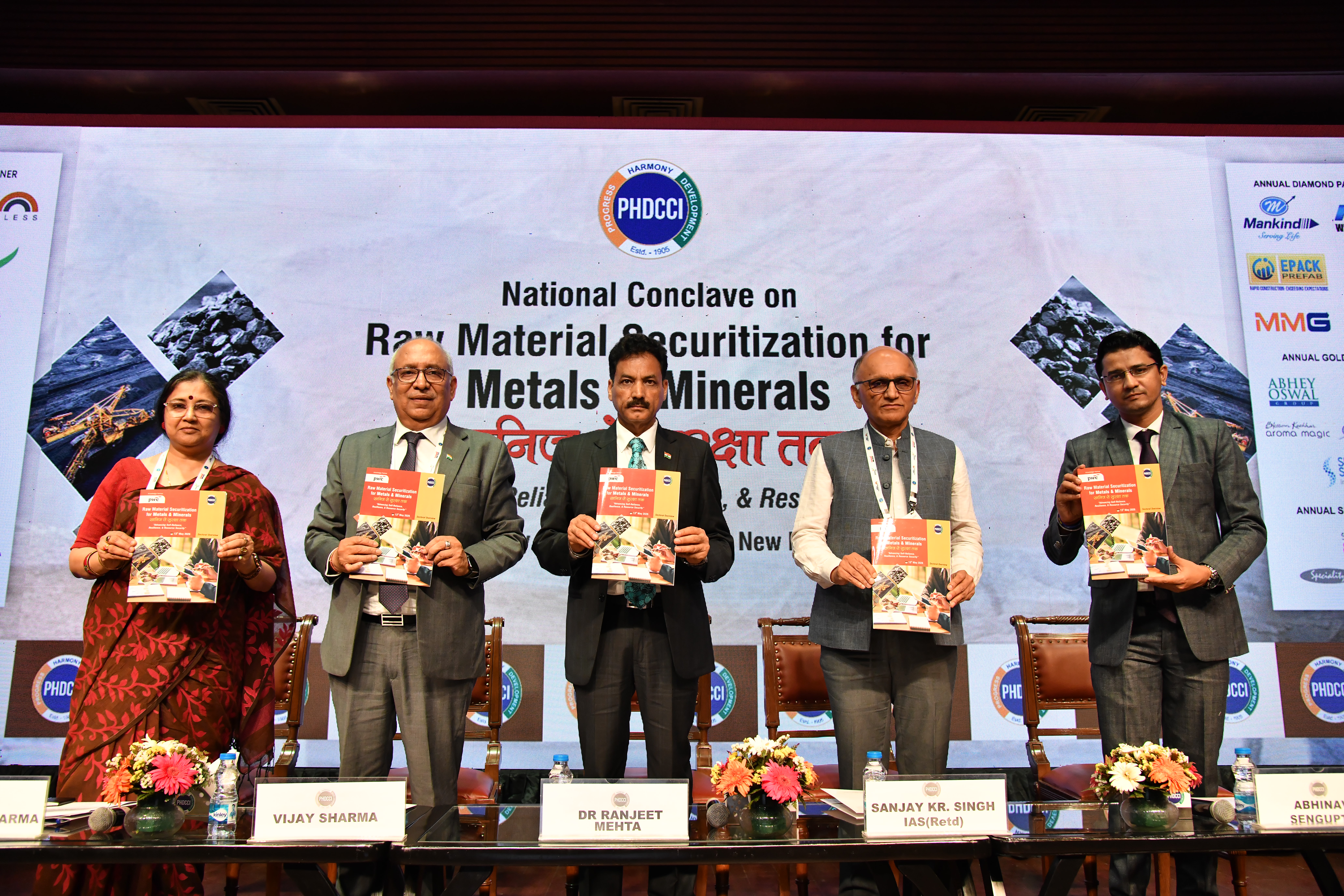
The conclave focused on the theme of advancing self-reliance, resilience, and resource security amid rising geopolitical conflicts, supply-chain disruptions, and increasing global resource nationalism.
Delivering the welcome address, Dr. Ranjeet Mehta, CEO and Secretary General, PHDCCI, stated that raw material security has emerged as a strategic and economic imperative for India amidst rising geopolitical conflicts, supply-chain disruptions, and growing global resource nationalism.
Mr. Vijay Sharma, Chair, Metals & Minerals Committee, PHDCCI and Director, Jindal Stainless Ltd., underscored that India’s infrastructure expansion and industrial growth are deeply linked to long-term raw material security and national economic resilience.
He noted that as India advances towards world-class infrastructure development across highways, railways, ports, urban infrastructure, renewable energy, defence manufacturing, and data centres, the demand for steel, stainless steel, critical minerals, and strategic resources is expected to rise significantly.
Speaking in the Opening session, Mr. Sanjay Kumar Singh, IAS (Retd.), Director, Jindal Steel Limited and Former Steel Secretary of India, urged that India must prepare today for the demands of a developed nation by strengthening raw material security, critical mineral access, and industrial self-reliance.
Referring to the steel sector as the backbone of infrastructure and economic development, he noted that India is primarily a consumption-driven steel market with rapidly rising demand and a strong domestic market for steel.
A report giving sectoral overview of steel, aluminium and critical minerals in India was released on this occasion. The report, prepared by PHDCCI in partnership with PwC India, emphasises that while India possesses significant geological resources, the country continues to face high import dependence on critical minerals such as lithium, cobalt, nickel, copper, and rare earth elements, alongside challenges related to coking coal and midstream processing capacities.
PHDCCI also launched the first edition of its quarterly Newsletter on Metals and Minerals sector on this occasion, highlighting key developments, industry insights, policy perspectives, and emerging trends in the sector.
The session on steel sector was moderated by Dr Pankaj Satija, Executive Vice President, JSW Group and featured distinguished speakers including Mr Alok Sahay, Secretary General & Executive Head, Indian Steel Association; Dr Anil Dhawan, Director General, Alloy Steel Producers Association of India; Mr Gaurab Chowdhury, Vice President, Jindal Stainless and Dr Abhinav Mathur, Advisor, Attero Recycling.
The session on aluminium was steered by Mr Abhinav Sengupta of PwC India. Among the eminent speakers were Mr Vijay Chauhan, Vice President - Mines, Hindalco Industries; Mr Ashim Roy, President, LSI Engineering & Consultants and Mr Ankur Aggarwal, General Secretary, Aluminium Extrusion Manufacturers Association of India.
The session on critical minerals was led by Mr Subhajit Chatterjee, PwC India and featured Dr Sukanya Chakraborti, CTO, Khanij Bidesh India Limited (Kabil); Dr Debajit Palit, Head, Centre for Climate Change & Energy Transition, Chintan Research Foundation; Mr Aditya Menon, Head, Public Policy & Strategy, Vedanta Limited - Sterlite Copper and Dr Tuasha Majumder, Senior Project Manager, Geovale Services.
The recycling session was moderated by Mr Ritesh Maheshwari, Director, Material Recycling Association of India & Executive Director, Shabro International. The speakers included Mr Vivek Prasad, Head – Partnerships & Supply Chain, Tata Steel and Mr Vikrant Singh, Co-Founder & CTO, BatX Energies.
The conclave witnessed participation from more than 150 delegates representing industry, associations, technology companies, institutions, policymakers, metals and mining companies, steel and aluminium industries, power and manufacturing sectors, exploration and mining technology providers, circular economy experts, research institutions, and academia.
The conclave was supported by Jindal Stainless Ltd. as the Stainless Partner, Jindal Steel as the Steel Partner, and Rashmi Group as the Associate Partner.
Partner associations included Indian Institute of Metals (Delhi Chapter); Pellet Manufacturers Association of India (PMAI); Alloy Steel Producers Association of India (ASPA); Indian Stainless Steel Development Association (ISSDA) & Material Recycling Association of India (MRAI).